Between the Player and the Sound

I was listening to The Cars’ “In Touch With Your World” the other day and found myself obsessing over a guitar tone.
If you’re not a guitar player, this may seem like an odd thing to spend time thinking about. But there is a moment during the chorus (got to about 1:17) where Elliot Easton comes in with this gloriously saturated sound that somehow manages to be both aggressive and beautiful at the same time. It’s thick without being muddy. There’s a slight “sag” that happens on the strike of each note. Distorted without being harsh. It practically jumps out of the speakers.
And, as guitar players have done for generations, I found myself wondering:
“How did he get that sound?”
That question has been on my mind more than usual lately because my father and I just finished building an 18-watt tube amplifier from scratch. In some ways, it owes a debt to classic Fender amplifiers from the 1950s. In others, there are echoes of old Marshall circuits. Into those inspirations, we incorporated modifications based on my father’s decades of experience working with radios, electronics, and things that generally contain enough voltage to encourage respect.
The story of that project deserves its own essay, and I promise I’ll share it when it’s ready. For now, however, it has led me directly into one of the longest-running debates in the guitar world: tube amplifiers versus digital modeling.
As debates go, this one can become surprisingly passionate!
Part of the reason is that an electric guitar is different from most musical instruments. A violinist can walk on stage carrying a violin and possess the complete instrument. A pianist sits down at a piano and everything needed to create the sound is already there.
An electric guitar is different.
Few performers intentionally walk on stage with an unplugged electric guitar and proceed with the show. The amplifier (along with whatever effects sit between the guitar and the amplifier) is part of the instrument itself. The sound doesn’t come from the guitar alone. It comes from the entire system. There is always something between the player and the sound.
Sometimes that’s a handful of tubes, transformers, resistors, and speakers. Sometimes it’s a powerful computer running sophisticated software. Either way, what sits in between shapes the experience as much as the result.
That makes the amplifier more than a piece of equipment. It becomes part of the musician’s creative process.
At their core, traditional tube amplifiers are surprisingly simple devices.
You don’t need to understand how to read an electrical schematic to appreciate that fact. In fact, that’s kind of the point.
This is the schematic of a late-1950s Fender Deluxe amplifier:
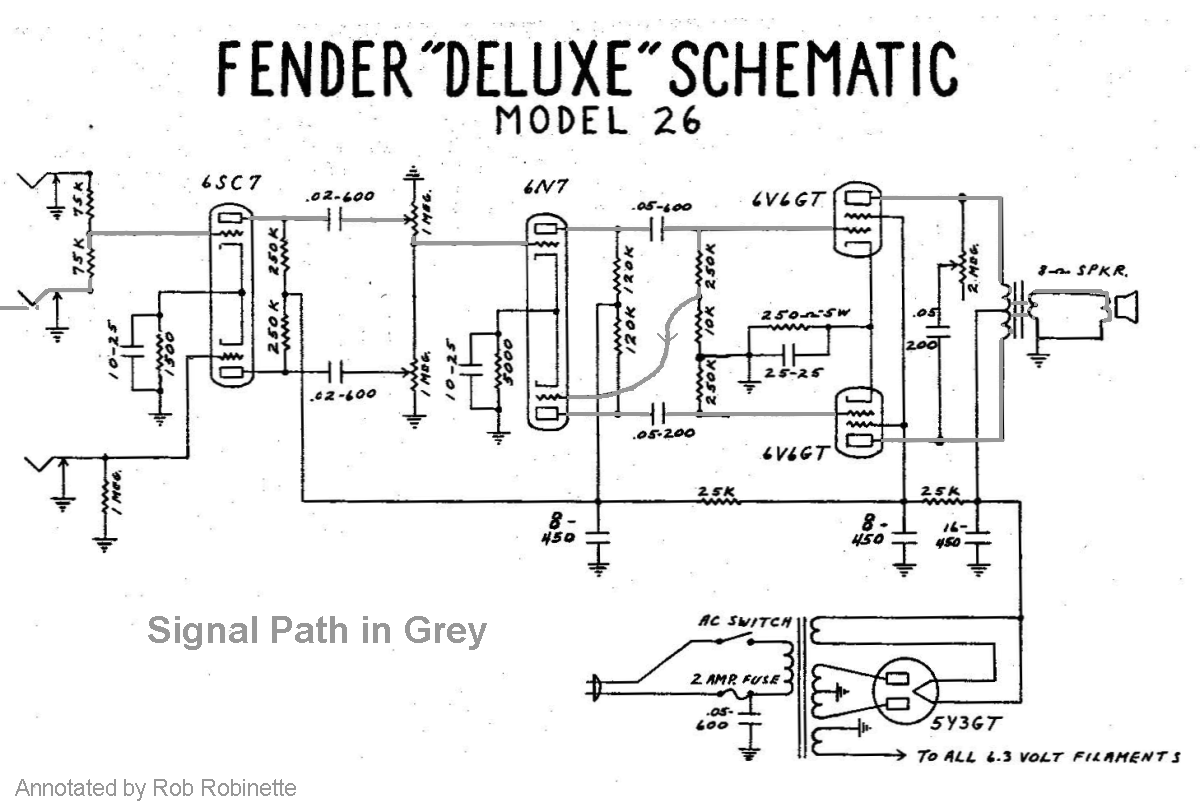
Even if you’ve never seen one before, you can probably follow the basic idea. The signal comes in, passes through a handful of stages, gets amplified, and comes out the other side louder and gloriously overdriven.
Now compare that to the architecture of a modern digital modeling amplifier:
Again, you don’t need to understand every detail…. And you can’t, because the schematics are proprietary and, well they’re computers.
So, here’s a detailed picture of a Pentium:
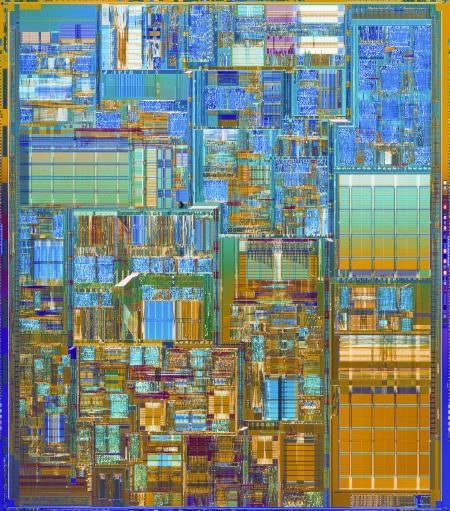
What matters is that the first amplifier is fundamentally creating its sound in real time through a relatively simple chain of physical components. The second is using extraordinary computational power to emulate not just one amplifier, but potentially dozens or hundreds of them.
The irony is that both approaches can produce excellent sounds.
I know because I use both.
When I record, I frequently use digital modeling software. It sounds fantastic. It is convenient, versatile, and allows me to access sounds that would otherwise require a warehouse full of vintage equipment and a substantially larger bank account.
Neither approach is inherently better, but they create a very different relationship between player and machine.
So this isn’t a story about one technology being superior to another. It’s about the relationship each technology creates between the musician and the instrument.
The best analogy I can think of is the difference between a manual transmission and an automatic. An automatic transmission is extraordinarily capable. In many situations it’s objectively more practical. You point the car where you want to go, press the accelerator, and the vehicle takes care of the rest.
A manual transmission asks more of the driver. You pay attention to engine speed. You think about gear selection. You feel the machine responding beneath you and listen for the engine to tell you when to shift. Driving becomes a more active and participatory experience.
The goal is still to get from Point A to Point B, but the journey simply feels different. Second and third gears in a curve are happy places, and if you drive stick you’ll understand what I mean.
For me, tube amplifiers occupy a similar space.
A good tube amp responds to how hard you attack the strings. It responds to changes in your guitar’s volume control. It compresses, distorts, and cleans up in ways that feel less like operating a machine and more like having a conversation with one. You don’t simply select a sound, you interact with it.
Will a tube amplifier always sound better than a modern modeler?
Honestly, I think that’s the wrong question.
Modern modeling technology is astonishing. The fact that a device sitting on a desk can convincingly reproduce the sound of dozens of classic amplifiers would have seemed like science fiction not all that long ago.
The better question is whether the experience is the same.
For me, it isn’t.
A tube amplifier asks for attention. It asks for participation. It rewards nuance. It creates a shorter path between the player’s hands and the resulting sound.
And perhaps that’s why my father and I spent months building one when there are easier, cheaper, and more practical alternatives available. Not because we’re chasing perfection but because we’re chasing connection.
And perhaps that’s true of more things than guitar amplifiers.
We live in a world increasingly optimized for convenience. More automation. More abstraction. More systems designed to smooth away friction and reduce the amount of attention required from us. Most of the time, that’s a wonderful thing.
But every so often there is value in choosing the more direct path. In choosing to participate rather than merely consume. In understanding not just what a tool does, but how it does it.
Maybe that’s why people still drive manual transmissions. Why some people still develop film photographs. Why musicians still spend countless hours learning instruments they could imitate with software.
Or why my dad and I spent months building an amplifier that can already be purchased with two clicks and a credit card.
The amplifier is finished, and It. Is. Excellent. The experience of building it together is the thing that will last.